
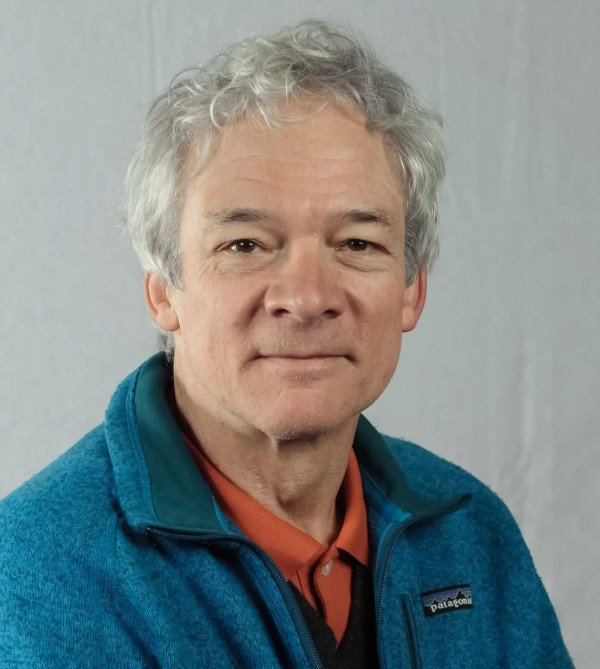
Profesor Titular, Instituto de Neurociencia, Facultad de Ciencias, Universidad de Valparaíso.
Director Alterno Instituto Milenio Centro Interdisciplinario de Neurociencia de Valparaíso
Centro Milenio Genómica de la Célula (CGC)(2007).
Ph.D. Brandeis University (1991)
Associate Professor, Cornell University (2004).
Información de contacto
Correo electrónico: john.ewer@uv.cl
Pasaje Harrington 287, Playa Ancha, Valparaíso, Chile.
Teléfono: (56)-(32)-2508040
Página web personal: https://www.ewerlab.org/
Me interesa el control del comportamiento mediante neuropéptidos y el reloj circadiano (biológico).
Durante varios años, mi laboratorio ha investigado el control neuroendocrino de la ecdisis, un comportamiento estereotipado que utilizan los insectos para desprenderse de su antiguo exoesqueleto al final de cada muda, y que sirve como un excelente modelo para comprender cómo los neuropéptidos desencadenan rutinas conductuales complejas. Hemos aprovechado las potentes herramientas genéticas y moleculares disponibles en Drosophila para comprender la función de cada neuropéptido y cómo actúan en conjunto para provocar la expresión de la secuencia de ecdisis.
También investigamos el mecanismo por el cual el reloj circadiano controla el momento de la ecdisis adulta. Para la mayoría de los estadíos, la ecdisis se activa al completarse la muda. Por el contrario, la ecdisis del adulto (también conocida como eclosión) también está controlada por el reloj circadiano, que restringe la eclosión a los períodos matutinos o vespertinos, según la especie de insecto. Dado que sabemos mucho sobre cómo funciona el reloj de la mosca y cómo se regula el comportamiento de eclosión (la ecdisis del adulto), la regulación de la eclosión por el reloj circadiano es un sistema excelente para investigar cómo este reloj impone una ritmicidad diaria a los procesos fisiológicos y conductuales.
• Scholz-Carlson E, Iyer AR, Nern A, Ewer J, Fernandez MP. (2025) Synaptic targets of circadian clock neurons influence core clock parameters. Sci Adv. 11(36):eadw4666. doi: 10.1126/sciadv.adw4666
• Cavieres-Lepe J, Amini E, Zabel M, Nässel DR, Stanewsky R, Wegener C, Ewer J. (2024) Timed receptor tyrosine kinase signaling couples the central and a peripheral circadian clock in Drosophila. Proc Natl Acad Sci U S A. 121(11):e2308067121. doi: 10.1073/pnas.2308067121
• Wegener C, Amini E, Cavieres-Lepe J, Ewer J. (2024) Neuronal and endocrine mechanisms underlying the circadian gating of eclosion: insights from Drosophila. Curr Opin Insect Sci. 66:101286. doi: 10.1016/j.cois.2024.101286
• Palacios-Muñoz A, de Paula Moreira D, Silva V, García IE, Aboitiz F, Zarrei M, Campos G, Rennie O, Howe JL, Anagnostou E, Ambrozewic P, Scherer SW, Passos-Bueno MR, Ewer J. (2022) Mutations in trpγ, the homologue of TRPC6 autism candidate gene, causes autism-like behavioral deficits in Drosophila. Mol Psychiatry. 27(8):3328-3342. doi: 10.1038/s41380-022-01555-1
• Mark B, Bustos-González L, Cascallares G, Conejera F, Ewer J. (2021) The circadian clock gates Drosophila adult emergence by controlling the timecourse of metamorphosis. Proc Natl Acad Sci U S A. 118(27):e2023249118. doi: 10.1073/pnas.2023249118.
• Flaven-Pouchon J, Alvarez JV, Rojas C, Ewer J. (2020) The tanning hormone, bursicon, does not act directly on the epidermis to tan the Drosophila exoskeleton. BMC Biol.18(1):17. doi: 10.1186/s12915-020-0742-5.
• Scott RL, Diao F, Silva V, Park S, Luan H, Ewer J, White BH. (2020) Non-canonical Eclosion Hormone-Expressing Cells Regulate Drosophila Ecdysis. iScience. 23(5):101108. doi: 10.1016/j.isci.2020.101108.
• Whitlock KE, Postlethwait J, Ewer J. (2019) Neuroendocrinology of reproduction: Is Gonadotropin-Releasing Hormone (GnRH) dispensable? Front Neuroendocrinol. 53:100738 doi: 10.1016/j.yfrne.2019.02.002. Review
• Selcho M, Millán C, Palacios-Muñoz A, Ruf F, Ubillo L, Chen J, Bergmann G, Ito C, Silva V, Wegener C, Ewer J. (2017) Central and peripheral clocks are coupled by a neuropeptide pathway in Drosophila. Nat Commun. 8:15563. doi: 10.1038/ncomms15563.
• Mena W, Diegelmann S, Wegener C, Ewer J. (2016) Stereotyped responses of Drosophila peptidergic neuronal ensemble depend on downstream neuromodulators. Elife. 5. pii: e19686. doi: 10.7554/eLife.19686.
• Diao F, Ironfield H, Diao F, Luan H, Shropshire W, Ewer J, Marr E, Potter CJ, Landgraf M and White BH (2015) Plug-and-Play Genetic Access to Drosophila Cell Types Using Exchangeable Exon Cassettes. Cell Reports. 10(8):1410-21. Doi: 10.1016/j.celrep.2015.01.059
• White BH, Ewer J. (2014) Neural and Hormonal Control of Postecdysial Behaviors in Insects. Annu Rev Entomol. 59:363-81. Doi: 10.1146/annurev-ento-011613-162028.
• Grbic M, Van Leeuwen T, Clark RM, Rombauts S, Rouzé P, Grbic V, Osborne EJ, Dermauw W, Ngoc PC, Ortego F, Hernández-Crespo P, Diaz I, Martinez M, Navajas M, Sucena É, Magalhães S, Nagy L, Pace RM, Djuranovic S, Smagghe G, Iga M, Christiaens O, Veenstra JA, Ewer J, Mancilla R, Villalobos RM, Hutter JL, Hudson SD, Velez M, Yi SV, Zeng J, Pires-daSilva A, Roch F, Cazaux M, Navarro M, Zhurov V, Acevedo G, Bjelica A, Fawcett JA, Bonnet E, Martens C, Baele G, Wissler L, Sanchez-Rodriguez A, Tirry L, Blais C, Demeestere K, Henz SR, Gregory TR, Mathieu J, Verdon L, Farinelli L, Schmutz J, Lindquist E, Feyereisen R, Van de Peer Y. (2011) The genome of Tetranychus urticae reveals herbivorous pest adaptations. Nature. 479(7374):487-92. doi: 10.1038/nature10640.
- 2025 – 2035 Instituto Milenio Centro Interdisciplinario de Neurociencia de Valparaíso (CINV), ICN2025_02. Director Alterno
- 2024 – 2028 Genetic screen in Drosophila to identify genes that regulate the function of vertebrate connexin 26 (Cx26), followed by analysis in mammalian systems to investigate their contribution to causing human deafness. Proyectos de Exploración 13240159. Director.
- 2024 – 2026 Centro Interdisciplinario de Neurociencia de Valparaíso (CINV), CIDI Regular, CIDI-8. Investigador.
- 2022 – 2026 Circadian control of Drosophila behavior. ANID, Fondecyt Regular n°1221270 Investigador Responsable.
- Alvaro Monsalve, PhD en Ciencias mención Neurociencia – UV
- Camila Almarza, Asistente de Investigación
- Diego Zavala, Asistente de Investigación
- Felipe Vergara, Asistente de Investigación